Project context
At a glance
⚙️ Product: Centralised subscription delivery platform used by all operational teams.
⚠️ Existing issues: Subscription progress was fragmented across departments, requiring manual reconciliation at handover points.
📉 Business impact: No reliable source of truth. Operational inefficiencies increased the risk of delays and inconsistent service delivery.
🎯 Product goal: Establish a shared and reliable source of truth across departments and management.
🧭 Strategic value: Standardise subscription delivery to improve accountability and long-term scalability.
Problems to address
Limitations and risks of the existing model
Operational inefficiencies
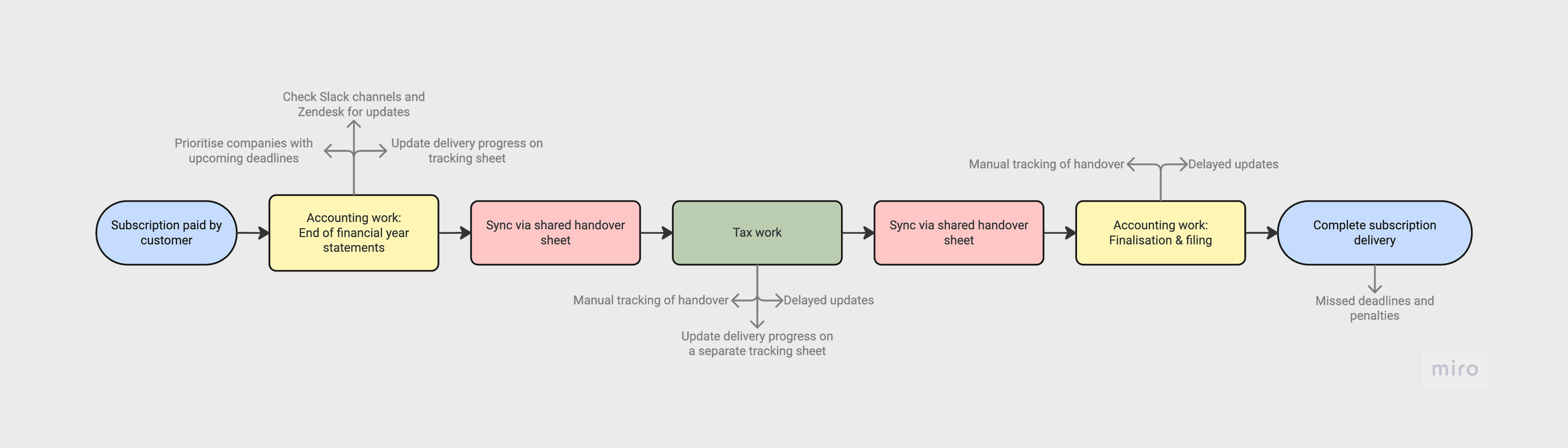
- Manual reconciliation required at each handover between teams
- High coordination overhead and increased likelihood of delays
Accountability gaps
- No audit trail or change logs to trace transitions
- Difficulty investigating and reporting delivery issues
Scalability constraints
- Execution relied on informal team knowledge rather than standardised lifecycle progression
A subscription’s delivery status required reconciling multiple data sources and coordinating across several teams.
Project scope
Defining the core delivery system
PMs drove the discovery phase to document and standardise the subscription delivery process, aligning stakeholders and operations teams. They began with accounting services, mapping tasks, assigning owners, and sequencing activities across teams to establish a repeatable workflow.
To establish a clear MVP, we prioritised high-impact workflows that addressed the core needs of each user role. This focused scope allowed us to build a proof of concept quickly and gather actionable insights through early user testing.
User
Needs
Page
Designing a solution
Subscription progress page: Surfacing the right information
Exploratory prototype
Without any prior internal system for tracking subscription progress, I created an initial prototype to test assumptions about what users would need to see and how information should be structured.
User testing observations:
- Completion percentages unclear: Subscription-level progress was difficult for users to interpret, as they were used to monitoring progress only within their team's work.
- Task counts confusing: Task totals varied across subscription tiers, leaving users unsure how many tasks to expect across all teams.
- Navigation mismatch: Users were redirected to a filtered task dashboard, but didn’t immediately recognise the filter, making it hard to identify the tasks for the subscription.
Reiterated dashboard
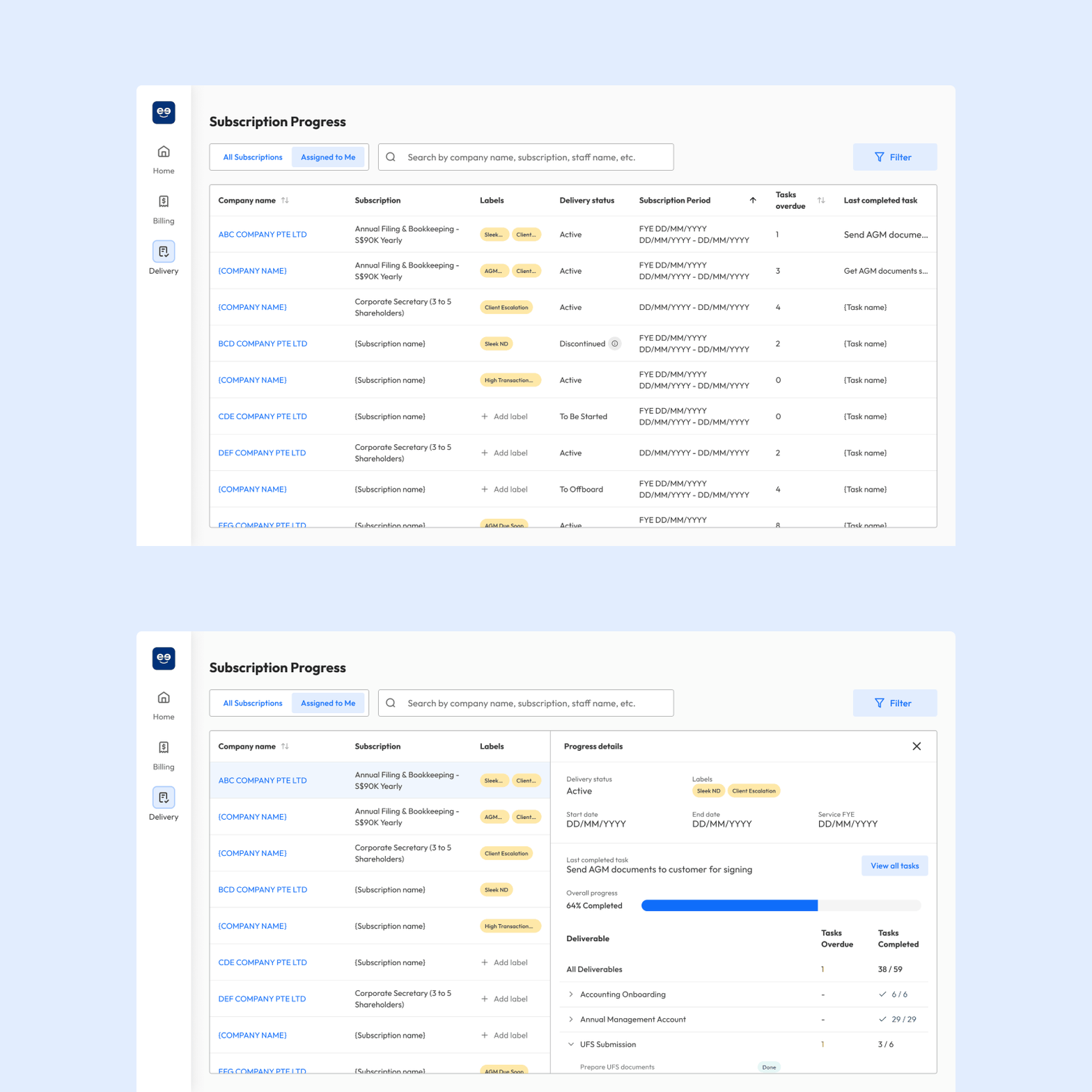
I incorporated user feedback and insights to address friction points and surface the most relevant information, enabling users to understand subscription progress at a glance.
Key improvements:
- Show last completed task: Provides a familiar reference point for users to gauge progress, reflecting how they already track tasks within their teams.
- Add company-level labels: Supports prioritisation of subscriptions at a company level.
- Expandable side panel for details: Progressive disclosure reveals subscription progress and a consolidated task list, reducing clicks and avoiding page redirects.
Reflection
Leveraging familiar mental models
Combining common patterns from existing tools with users’ spreadsheet-based workflows guided our design decisions, ensuring the new platform felt intuitive while consolidating processes across teams.
Continuing to validate designs against real user behaviour will be critical to ensure adoption and the successful consolidation of all teams onto a single platform.